AI Face Analyzer
Upload a photo and get a free face report: a score out of 10, where you stand among people your age, and the measurements behind it. The free analysis runs in your browser, so your photo is not uploaded.
Example result (AI-generated sample face)
Your score
6.9 / 10
Top 17% of women
One photo is accurate to about ±1.8. A different photo of you can score higher or lower.
 Symmetry 59Face contour 60
Components
- Overall harmony (Highest)
- 66
- Symmetry
- 59
- Face contour
- 60
- Feature proportions
- 56
- Softness (Lowest)
- 39
Measured separately. Your score is not their sum.
How the face analyzer works
1. Add a photo
Choose a photo you already have, or take one with your camera: the page checks the framing before you shoot. The face analyzer starts immediately and runs inside your browser, so nothing is sent to us. The first run downloads about 22 MB of models; after that it works from cache. One photo gives one result. The same person can score noticeably differently from photo to photo, so try another photo if the first result surprises you.
2. Check who you are compared with
There is nothing to fill in first. The page reads from the photo whether to compare you with men or with women, and adjusts the score for age on its own; if the photo leaves it unclear, it asks. You can change both under your result. The age adjustment matters: without it, people in their fifties would land about two points below people in their twenties for no reason other than age.
3. Read your face report
Your face report shows your score with its error range, your percentile, and the components with the lines we measured drawn on your photo. You can save it as a share card, with or without your picture.
What the AI face analyzer measures
The score comes from a compact neural network that looks at the whole face in the photo. It was trained on about 4,600 portraits from a public research dataset and then checked against ratings from 2,513 people. Underneath the score, the AI face analyzer also takes classic measurements from 478 points located on your face and reports them as components:
how close your proportions sit to the average face of your group. Faces near the average tend to be rated higher.
the height difference between twelve pairs of matching points on the left and right.
width against height, and how defined the outline is.
mainly eye width relative to face width.
how far the face shape leans toward the typical female shape. Shown for women only, so men see four components.
Each component is compared with the same reference group and shown on the same scale. The overall score is produced separately, so you can see strong components next to an ordinary score, or the reverse. Treat the components as a description of your face, and the score as an estimate of how a stranger would rate the photo.
How accurate is a face analyzer?
We tested the face analyzer on 102 studio portraits from a public research set, each rated by the same large panel. Its scores correlate about 0.6 with the average human rating, on a measure where 0 means no relation and 1 means perfect agreement. For comparison, one randomly chosen person agrees with that average at 0.56 to 0.63, so the face analyzer is roughly as good as asking one stranger. It is well short of a panel.
The larger source of error is the photo. Across different pictures of the same person, results swing enough that a single photo is only accurate to about ±1.8 points. That is why the result always comes with a range. The same photo always returns the same score, because the calculation involves no randomness.
Three things move the number that have nothing to do with your face. Smiling adds about 0.4. An underexposed photo, where the whole image is darker, adds up to 0.7. A photo where the face is smaller than 80 pixels wide, or the head is turned more than 20 degrees, is not scored at all; you get a message asking for another photo instead of a guess.
What's in the full face analysis report
The paid face analysis report is for people who want the detail and something to act on. It costs $9.99 once, with no subscription, and takes about 45 seconds to prepare. It contains:
grouped by brows, eyes, nose, mouth, lower face and overall shape. Each shows your value, the group average and your percentile, with the line drawn on your photo.
generated from your own photo and checked so the face stays yours.
of your face, part by part (brows, eyes, nose, mouth, jaw and overall shape), that quotes only measured numbers and never recommends surgery.
three to five changes ordered by effort, each tied to what was measured on your face and, where there is one, to the image that shows it.
how light or deep your coloring is, how much contrast there is between your skin and hair, and whether an AI reads your skin as leaning warm or cool.
how much of the score is down to the photo itself.
You can save the face analysis report as a PDF. The measurements describe how your face differs from the average of your group, which is the information a hairdresser or stylist works from. We do not label each one good or bad, because a single measurement says little about how a face is rated.
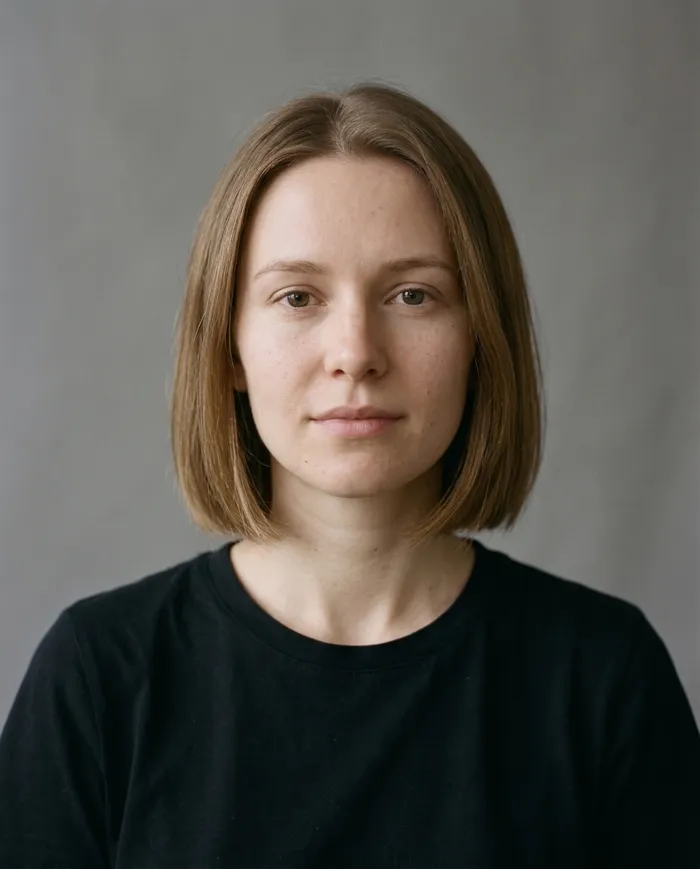
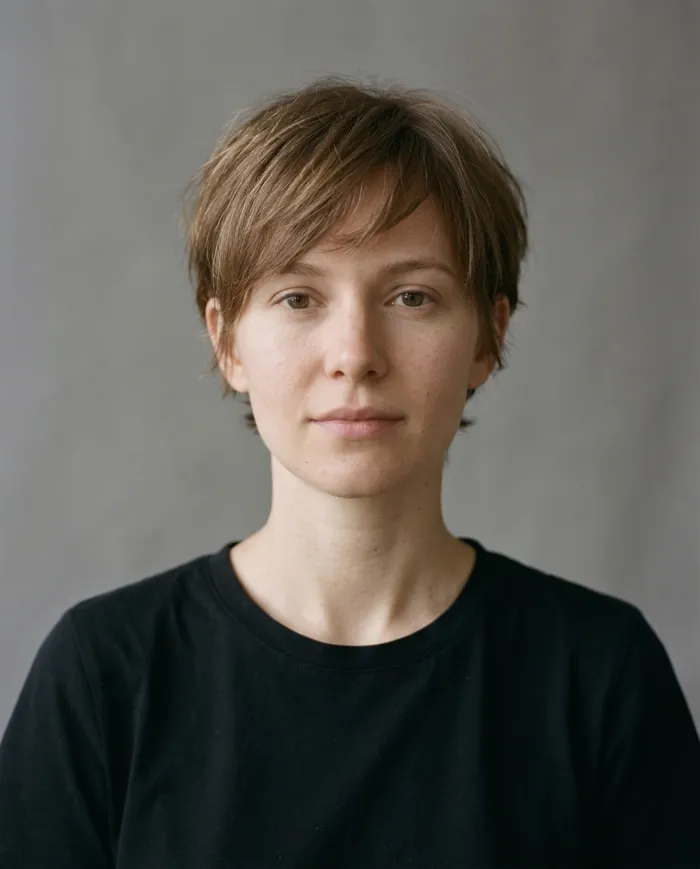
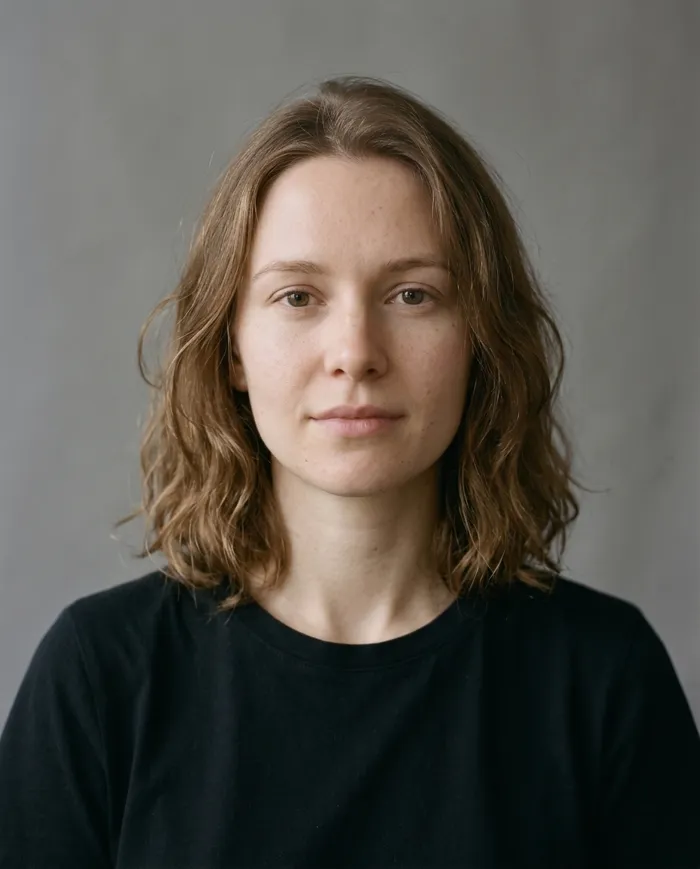
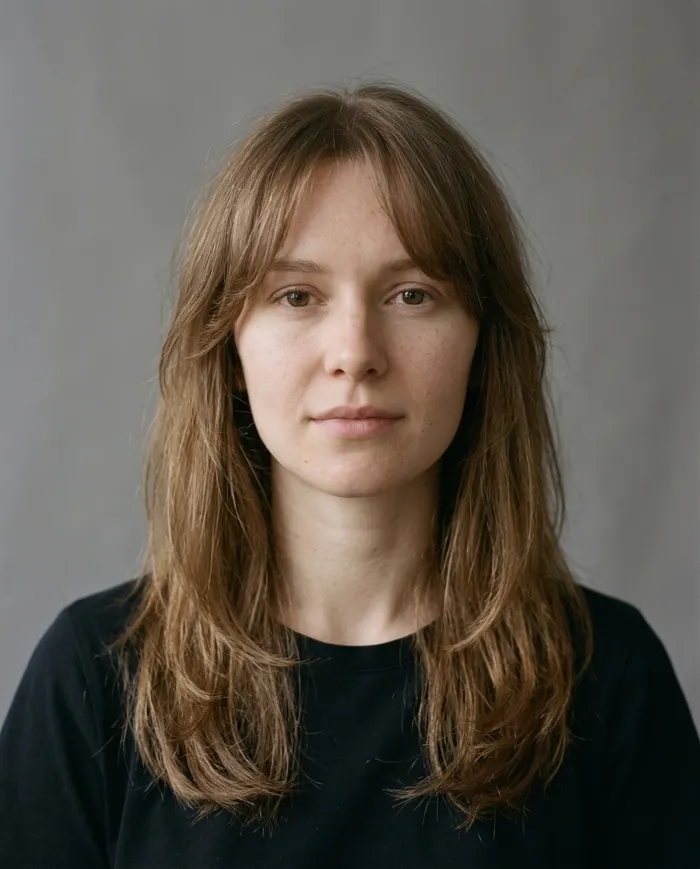
Example from an AI-generated sample face
Who uses it
The AI face analyzer is built around two requests that keep appearing in app reviews and forums. One is a number with a percentile and a clear idea of what to change first, without being pushed toward procedures. The other is plain advice on what suits a face: hairstyles, contrast, color. The report text and the generated images are produced separately for men and for women.
Photo tips for a steadier result
Use daylight from the front, hold the camera at eye level and at arm's length or further, and keep your whole face in frame. Very close selfies distort proportions. Glasses are fine. Masks, hands and microphones in front of the face are not, because hidden points are guessed. Beauty filters and heavy retouching change what is measured, so use an unfiltered photo. If you try more than one photo, pick ones from different days and places: three frames from one sitting tell you little more than one.
Your photos stay yours
The free face analyzer never uploads anything. Detection, scoring and the measurement lines all run on your device, and closing the tab removes the result. The paid report is the only part that needs your photos on a server, because the images are generated there. Before paying you confirm that the photos are of you and that you are 18 or older. Report photos are kept for 30 days so you can come back to them, you can delete them at any time with one click, and they are not used to train models.
Face analyzer FAQ
Is the AI face analyzer free?
Yes. The score, the percentile, the components, the measurement lines and the share card are free with no daily limit, because they are computed on your own device and cost us nothing to run. Only the full face report is paid.
Do I need to create an account?
No. The free face analyzer has no login at all. If you buy a report, the email you enter at checkout is the key to reopen it later; there is no password to set.
What is a good score?
The scale is built so that 5.5 is the average for your gender and age group. About two thirds of people fall between 4.0 and 7.0. A 7.0 is higher than roughly 84% of the group, and 8.5 is higher than about 98%.
Why not just ask ChatGPT to analyze my face?
You can, and it will write you a friendly paragraph. Its answer changes each time you ask, and it tends to flatter. This face analyzer places the number against a reference group, and each component can be traced to lines on your photo.
Does facial analysis work for every age and ethnicity?
The reference group covers adults aged 20 to 59 across seven broad ethnic groups, about equal numbers of each. People aged 18 or 19 are compared with the 20–29 group and people over 59 with the 50–59 group, and the result says so. It is not offered to anyone under 18. You are compared with everyone of your gender and age group, not within one ethnicity. In the reference data, group averages differ by up to 0.3 points among men and about 0.65 among women, a preference the model picked up from the ratings it learned from. The human ratings used for validation came mostly from young adults photographed in a studio, so accuracy is best established for that kind of photo.
Can I get a refund on the report?
Yes. Write to us within 7 days of purchase and we refund it. If a report fails to generate, the refund is automatic.